

Dry air creates an invisible hazard inside electronic manufacturing facilities. Unseen electrostatic discharges cause immediate component failures and hidden defect risks that cost time and money. Managing moisture levels with reliable anti static products remains a fundamental requirement for maintaining safe assembly spaces.
Understanding how atmospheric moisture interacts with sensitive microelectronics allows engineering teams to control unwanted static accumulation effectively. Controlling electrostatic discharge requires a balanced approach combining environmental management and targeted neutralization techniques.
How Relative Humidity Shapes Electrostatic Discharge Risk
Relative humidity measures the amount of water vapor present in the air compared to the maximum amount possible at a given temperature. Moisture in the air forms an invisible, micro-thin conductive film on surface materials. This tiny layer helps harmlessly dissipate electric charges before high voltages build up.
When ambient moisture drops below forty percent, static generation accelerates rapidly. Walking across a standard floor in dry conditions easily generates thousands of volts. That same movement in a high-humidity environment generates only a fraction of that charge.
Direct Impact of Low Moisture Levels
- Rapid voltage spikes on ungrounded operators and plastic equipment
- Decreased natural surface conductivity on handling tools
- Increased attraction of airborne dust particles to sensitive components
- Heightened risk of latent component defects during final assembly
Long-Term Benefits of Controlled Environmental Humidity
Maintaining precise humidity levels safeguards electronic assemblies throughout every stage of production. Stable moisture levels protect fragile delicate micro-components from unseen static damage while preventing moisture-induced corrosion on sensitive soldered surfaces. Balanced atmospheric conditions create a reliable baseline that improves production yields, reduces costly warranty repairs, and ensures high product quality over time.
Structural Challenges of High Moisture Levels
- Risk of physical corrosion on exposed metals and solder pads
- Solder joint failure during high-temperature reflow processes
- Uncomfortable working conditions for assembly operators
- Accelerated degradation of delicate biological or chemical reagents
Maintaining ambient relative humidity between forty and sixty percent provides a balanced safeguard for standard electronic manufacturing environments.
Environmental Control Limits and Non-Conductive Materials
Humidity control alone does not solve every electrostatic challenge in modern electronics production. Many modern assembly spaces use specialized polymers, clear acrylic covers, glass panels, and synthetic tray holders. These non-conductive materials are insulators. Moisture films cannot form easily on insulating surfaces, meaning charges remain trapped regardless of ambient room moisture.
Standard ground wires and grounding straps bleed off charge from conductive items like metal tools or human skin. However, insulators retain static electricity even when connected directly to a grounding point.
Adding anti static spray or raising room humidity helps conductive surfaces, but insulators remain charged. Supplemental static control measures become vital when dealing with high-insulation materials near sensitive printed circuit boards.

Active Neutralization: When Air Ionisers Become Essential
Air ionisers actively neutralize static charges on insulating surfaces where traditional grounding methods fail. These devices flood the immediate work area with balanced streams of positive and negative air ions.
When a charged insulating object passes near an ioniser, it attracts ions of the opposite polarity. This interaction neutralizes the surface charge within seconds, preventing sudden electrical discharges.
Primary Operational Scenarios for Ionisation
- Handling flat plastic trays, clear tape reels, and synthetic packaging material
- Protecting automated pick-and-place feeders operating at high speeds
- Neutralizing optical lenses, display glass, and protective plastic films
- Managing cleanroom enclosures where humidity levels must remain low
Choosing the correct neutralization method depends entirely on the specific materials used and local working conditions.
Integrated Static Protection Across Assembly Workstations
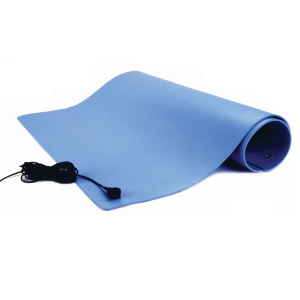
Combining environmental humidity controls with dedicated physical grounding builds a resilient production floor. Workstations equipped with grounded esd mats dissipate surface charges safely from operators, metal tools, and conductive containers. This continuous charge removal prevents sudden electrical discharges, creating a consistently safe working zone for high-density surface-mount components.

Building a Layered Electrostatic Defense Strategy
Relying on a single control method leaves assembly lines vulnerable to unexpected static events. A robust protection plan layers passive grounding, environmental controls, and active ionisation together.
Essential Protective Elements
- Grounded Workstations: Equipping assembly tables with durable esd mats ensures conductive items and wrist straps connect safely to a common ground point.
- Topical Surface Treatments: Applying anti static spray to non-sensitive packaging areas or temporary holding bins slows down initial charge accumulation.
- Targeted Air Ionisers: Positioning overhead or benchtop ionisers near focal assembly zones neutralizes static on insulating components.
- Continuous Environmental Monitoring: Installing digital hygrometers ensures facility managers track humidity shifts across changing seasonal weather.
Combining these four protective layers builds a resilient defense system that adapts to changing climate conditions and varied production materials.
Targeted Neutralization with Specialized Surface Treatments
Surfaces near sensitive assembly lines often generate static through friction during daily handling and component transport. Applying an anti static spray to non-sensitive material trays, storage bins, and nearby work surfaces neutralizes static build-up before components reach assembly. This targeted preventative measure reduces charge generation on secondary materials without interfering with delicate electronic circuitry.
Conclusion
Managing static risks inside modern electronic manufacturing facilities requires constant attention to atmospheric conditions and workplace materials. Relative humidity plays a central role in controlling static build-up on conductive surfaces, but non-conductive insulators need active neutralization. Layering ambient moisture management with grounded workstations, protective surface treatments, and targeted air ionisers keeps production lines safe from costly static damage.
At ELCOM, we design and deliver reliable static control solutions, helping manufacturing teams protect delicate electronics, improve yield rates, and maintain safe, compliant production environments.
Frequently Asked Questions
Why is humidity control alone insufficient for static protection?
Relative humidity creates a conductive moisture layer on surfaces, but insulators like plastic, glass, and synthetic tape resist moisture formation. Static electricity stays trapped on insulating materials even in humid rooms, requiring active ionisation to neutralize charges.
What relative humidity range is best for electronics manufacturing?
The recommended relative humidity range for electronics manufacturing is between forty and sixty percent. This range minimizes static electricity accumulation without causing metallic corrosion or component damage from excessive moisture.
How do static mats differ from active air ionisers?
Static mats provide a direct electrical path to ground for conductive and dissipative materials, such as metal tools or grounded wrist straps. Active air ionisers produce streams of positive and negative air ions to neutralize charges on non-conductive, insulating materials that cannot be grounded.
Where should surface sprays be used in an assembly facility?
Surface sprays work best on non-sensitive, secondary surfaces like holding bins, plastic trays, tote walls, and synthetic flooring. They help reduce friction-induced static generation across high-traffic workstation areas.